

Executive Stress™ & Alcohol Use
You Can Be Good At Handling Pressure And Still Need A Better Way To Manage It.
You've built a career that comes with responsibility. People count on you to make decisions, solve problems, manage competing priorities, and keep things moving, often when there isn't enough information, time, or support to do everything as well as you'd like.
And you do it. Day after day. But being able to handle something doesn't tell us much about what it's costing you. Maybe you've noticed that:
It takes longer to unwind after work.
Your patience isn't what it used to be.
You're physically home but still mentally working through the day's conversations, decisions, and unfinished business.
By the time you have an opportunity to do something for yourself or spend time with people you care about, there isn't much left.
And somewhere along the way, alcohol may have become one of the ways you manage that transition. If you've tried changing your drinking without much lasting success, I want to introduce you to something that may help explain why.
Executive Stress™.
Explore Executive Sobriety Coaching
Executive Stress™ Isn't Just Having A Stressful Job.
You may be responsible for other people's livelihoods, safety, performance, or well-being. You may be expected to make decisions with incomplete information, anticipate problems before they develop, manage difficult personalities, and deliver results despite circumstances you cannot control.
Some of the most significant sources of Executive Stress™ aren't necessarily the most obvious.
Consider how much of your professional life involves:
Managing change while maintaining daily operations.
Being accountable for outcomes that depend on other people.
Navigating organizational politics, interpersonal conflict, or difficult senior leadership.
Making decisions when none of the available options is particularly good.
Managing expectations that exceed the time, staffing, or resources available.
Dealing with ethical dilemmas, role ambiguity, or concerns about job security.
Remaining accessible when your workday is technically finished.
Carrying the additional demands of travel, commuting, or unpredictable schedules.
And, of course, your professional responsibilities aren't the only demands on your time and attention.
There may be children, aging parents, relationships, household responsibilities, financial decisions, health concerns, and a dozen other things that don't disappear because you've had a difficult day at work.
Executive Stress™ is about more than how busy you are. It's about the demands you're managing, the resources available to meet them, and the ways you've learned to function under that pressure.
Understanding that relationship gives us something much more useful to work with than simply telling you to reduce stress.
You're Still Functioning. But How Much Is It Costing You?
If stress were becoming unmanageable, surely your performance would suffer. If drinking were becoming a problem, surely there would be some unmistakable consequence.
Except that's not necessarily how it works.
Many of the professionals I work with are meeting deadlines, managing employees, taking care of their families, paying their bills, and continuing to advance professionally. Some are performing exceptionally well.
They've become very good at continuing to function under considerable pressure.
But functioning is only one measure of how things are going.
What happens when the workday ends?
How much time and energy do you have available for your relationships, interests, and personal responsibilities?
How much effort does it take to relax?
How often do you find yourself thinking that things will get better after the next project, the next quarter, or the next major deadline?
And how much have you come to rely on a particular way of shutting everything off?
You don't have to wait until your performance declines, your relationships suffer, or your health becomes a concern to decide that something needs to change.
Sometimes the earliest indication is that you're still doing everything you've always done.
It's just taking considerably more out of you than it used to.
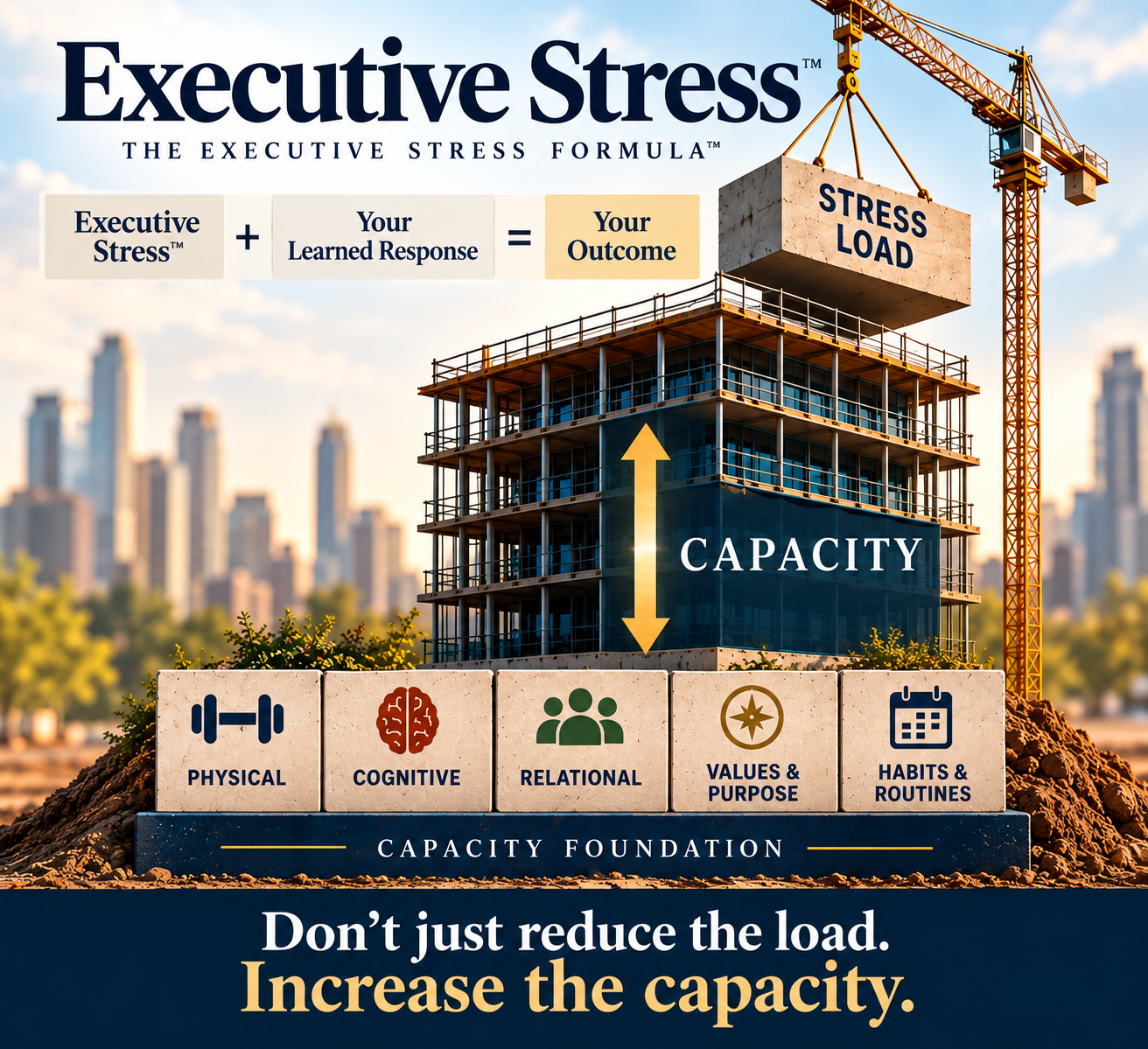
Let's talk about load and capacity.
I often use construction and structural concepts to explain Executive Stress™ because they give us a practical way to think about a problem that can otherwise feel vague.
People aren't buildings, of course. But the relationship between load, capacity, and support is a useful way to understand what happens when responsibilities accumulate.
Your load includes the work you're doing, the decisions you're making, the responsibilities you're carrying, and the mental space occupied by everything you're trying to keep track of.
Your capacity includes the time, energy, attention, resources, skills, and support available to meet those demands.
Every structure is designed to carry a certain load. How well it performs depends on the demands placed on it, its available capacity, and the supports that distribute the weight.
And those aren't fixed quantities. Your available capacity can change depending on sleep, health, competing responsibilities, relationships, staffing, financial resources, and a host of other circumstances.
You might be able to manage a demanding workweek quite effectively when the rest of your life is relatively stable. That same workload can become considerably more difficult when you're also dealing with a family crisis, a difficult employee, an organizational transition, or a health concern.The workload didn't necessarily change. Your available capacity did.
This is why I don't assume the answer is always to reduce your responsibilities. Sometimes we do need to reduce the load. That may mean setting boundaries, changing expectations, delegating, improving systems, or deciding that something no longer deserves the resources it's consuming. Other times, we need to increase capacity by improving the supports, routines, habits, and resources available to us.
Frequently, we need to do some of both.
Don't just reduce the load. Increase the capacity.
And before deciding what to change, we need to understand how your particular system is operating.
The Way You Manage Executive Stress™ Is Something You've Learned.
Here's where my background in addiction, behavioral science, and habit formation becomes particularly useful.
When something produces a desirable result, your brain learns from it.
That result might be relief, distraction, a sense of control, stimulation, comfort, or the ability to keep functioning when you're exhausted.
And when you encounter similar circumstances again, you're more likely to repeat what worked before.
That's not necessarily a problem. In fact, it's part of how we become efficient at managing complicated lives.
You don't have to consciously think through every decision, routine, and response. Your brain has learned patterns that allow you to function without starting from scratch every day.
But efficiency and effectiveness aren't always the same thing.
A habit may continue because it reliably produces a short-term benefit, even when its longer-term consequences are becoming less desirable.
Consider the professional who responds to anxiety by preparing more thoroughly, checking everything twice, or taking greater control of a project. Those strategies may produce excellent results. They may also become so automatic that the person has difficulty recognizing when additional preparation is no longer useful.
Or the person who responds to pressure by working longer hours. Initially, that extra effort may solve the immediate problem. Eventually, it may become their default response to almost every problem.
Alcohol can become part of that same pattern.
Perhaps it started as an enjoyable part of an evening or a way to celebrate the end of a demanding week. Over time, it became associated with the moment you could finally stop making decisions, stop responding to other people's needs, and relax.
Your brain learned that alcohol provided a particular result.
And the more often you repeated that pattern, the more familiar and automatic it became.
That doesn't mean alcohol is the only thing contributing to the problem. Nor does it mean that everyone experiencing Executive Stress™ develops a problem with drinking.
It means that understanding what you've learned to do in response to stress is an important part of understanding what needs to change.

The Executive Stress Formula™
Executive Stress™
+ Your Learned Response
= Your Outcome
This is one of the organizing principles of my work. You may not be able to control every demand placed on you, but you have considerable influence over how you respond to those demands. And that gives us something useful to work with.
When pressure builds:
What do you automatically do?
What does that behavior accomplish in the short term?
What happens afterward?
Does the result still support the life you're trying to live?
For some people, the learned response is alcohol. For others, it's overworking, controlling, withdrawing, procrastinating, overthinking, or becoming increasingly irritable. Often, it's a combination.
The important thing is to identify the pattern rather than assuming the behavior appeared for no reason.
When your learned response changes, your outcome can change, too.
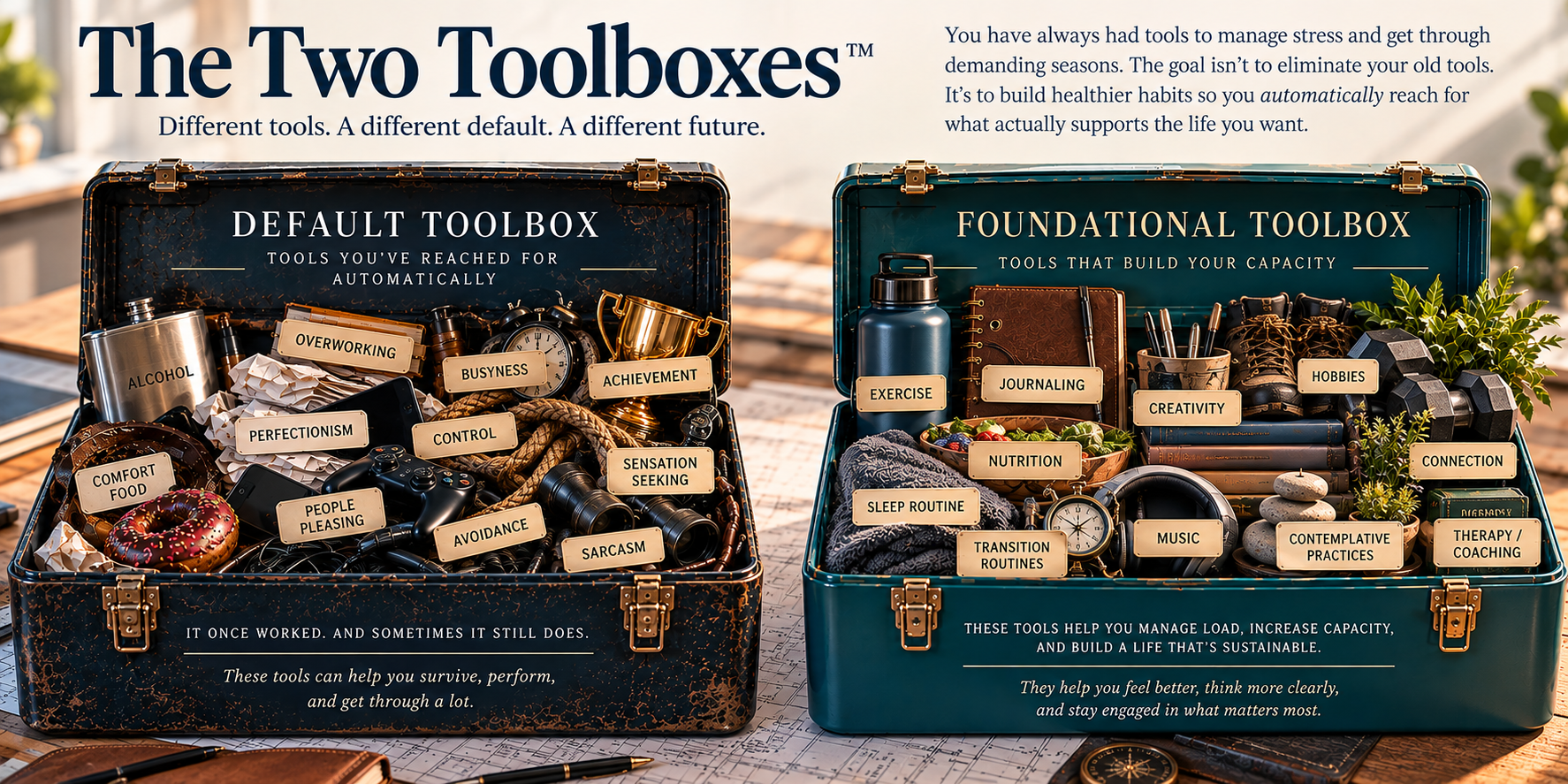
The Two Toolboxes™: What Are You Reaching For When Stress Shows Up?
We all have tools for managing stress, solving problems, and getting through demanding days. Some we've developed intentionally. Others have become so familiar that we reach for them without much thought.
I use a framework called The Two Toolboxes™ to help people examine those patterns and make more deliberate decisions about the tools they're using.
The question isn't whether you have tools. You already have plenty.
The question is which ones you're reaching for automatically, what they're accomplishing, and whether they're still producing the results you want.
Your Default Toolbox
Your Default Toolbox contains the responses you've practiced enough that they tend to show up automatically.
Those responses aren't necessarily bad, and they aren't always unhealthy. The defining characteristic is that they've become familiar habits.
Maybe you automatically make a list when you're overwhelmed, go for a walk when you're frustrated, or call someone you trust when you've had a difficult day.
Or maybe you:
Pour a drink.
Keep working.
Withdraw from people.
Become sarcastic.
Scroll through your phone.
Take control of something that doesn't actually need your attention.
These responses may look very different, but they have something in common: your brain has learned to reach for them.
Your Foundational Toolbox
Your Foundational Toolbox is the collection of resources, skills, routines, and supports you intentionally build and maintain because they help you manage your life more effectively.
These might include physical activity, sleep routines, supportive relationships, hobbies, realistic boundaries, practical planning systems, meaningful activities, and ways of transitioning between professional and personal responsibilities.
What belongs in this toolbox depends on your circumstances, preferences, needs, and resources.
And simply knowing that a tool would be useful doesn't mean you've developed the habit of using it.
You can understand the benefits of exercise and still never make time for it. You can know that a difficult conversation needs to happen and continue avoiding it. You can have an excellent stress-management plan that disappears the moment your calendar becomes crowded.
That's why habit formation matters.
Building a New Default
The goal isn't to create a perfect collection of healthy habits or eliminate every coping behavior you've ever used.
It's to examine the tools you currently rely on, understand the job each one is doing, and intentionally practice alternatives that serve you better.
The goal is to practice useful tools often enough that they become the ones your brain reaches for automatically.
The habits you've developed through repetition can be changed through repetition, too.
I call that building a new default.
And the new default needs to work in your actual life, not just during a quiet week when nothing unexpected happens.

Why Changing Your Drinking Without Addressing Executive Stress™ Can Be Difficult
If alcohol has become one of your primary ways of decompressing, removing it creates a practical question.
What will you do instead?
Not just on a good day, when you have time, energy, and enthusiasm for making changes.
What will you do after a difficult meeting, a long commute, an argument at home, a disappointing outcome, or a day when everyone seemed to need something from you?
What will you do when you're exhausted but your mind won't stop working?
If alcohol has been doing an important job in your life, we need to understand that job.
Perhaps alcohol has been:
Marking the end of the workday.
Helping you feel temporarily less responsible for everything.
Part of how you socialize, celebrate, reward yourself, or manage uncomfortable thoughts and emotions.
And perhaps you've already tried changing your drinking several times.
You may have established rules, set limits, taken breaks, changed what you drink, or promised yourself that this time would be different.
Some of those efforts may have worked for a while.
But if the circumstances that activate the habit haven't changed, and you haven't developed other reliable ways to meet the needs alcohol has been serving, it's understandable that the old pattern keeps showing up.
That's why I look beyond the drinking itself.
We examine your Executive Stress™ load, your available capacity, your habits, your expectations, your thinking patterns, and the resources you can realistically use.
We also look at what's already working. You haven't arrived here without strengths, skills, and successful strategies.
The objective is to build on those resources while developing alternatives that make alcohol less central to the way you manage your life.
You Don't Have To Lose Your Edge To Take The Edge Off.
I work with professionals who value their careers, their responsibilities, and the lives they've built.
I'm not interested in automatically treating ambition, achievement, leadership, or a strong work ethic as problems.
Those qualities may be important parts of your identity, and they may have contributed to things you genuinely value.
But I am interested in examining whether the ways you're managing those responsibilities are still working for you.
Can you make room for rest without feeling that you're falling behind? Can you manage an unexpected problem without automatically sacrificing everything else on your calendar? Can you finish work and have enough capacity left to participate in the rest of your life?
Can you enjoy an evening, a weekend, a vacation, or a celebration without depending on alcohol to make the transition?
The goal isn't to become someone who no longer cares about doing good work.
It's to develop ways of managing Executive Stress™ that allow you to continue doing meaningful work while having more time, attention, and energy available for everything else that matters to you.
Make room to enjoy the life you worked so hard to build.
Start With An Assessment, Not Another Promise To Try Harder.
If you've recognized yourself in this discussion, you don't need to make a dozen changes before deciding what to do next.
Start by understanding your current pattern.
The Executive Stress Audit™
The Executive Stress Audit™ is a free assessment I developed to help professionals examine the demands they're carrying and begin identifying how those demands may be influencing their coping habits.
It includes a structured look at Executive Stress Load™, questions about your current responsibilities and resources, and an opportunity to consider the patterns that may be affecting your relationship with alcohol.
It isn't a diagnosis or a judgment about how well you're handling your life.
It's a starting point for understanding what you're working with.
The Executive Recovery Blueprint Intensive™
If you'd like to take that assessment further, the Executive Recovery Blueprint Intensive™ provides an opportunity for a more comprehensive, individualized look at your relationship with alcohol, your Executive Stress™ patterns, your existing resources, and the changes you want to make.
We'll approach the work much as we would a root cause analysis: understanding the current situation, identifying what contributes to the pattern, evaluating what's working, and developing a practical plan.
You'll leave with a personalized Executive Recovery Blueprint™ designed around your circumstances and goals.
The Intensive is available as a standalone service or as a starting point for longer-term coaching.
Understand The Stress. Redesign the Response.
Executive Stress™ isn't necessarily going away. And you may not want to give up the responsibilities, opportunities, and accomplishments that have made your professional life meaningful.
But the way you manage those demands doesn't have to remain the same.
You can learn to recognize the patterns you've developed, make more intentional decisions about the tools you're using, and build additional capacity to support the life you want.
You don't have to dismantle everything that's working to change the parts that aren't.
Let's build what works.
Website footer disclaimer: Coaching through Sober in the C-Suite® is distinct from psychotherapy, medical care, and substance use disorder treatment. The Executive Stress Audit™ is an educational self-assessment, not a validated diagnostic instrument. Individuals who may need medical detoxification, clinical treatment, or other healthcare services should seek appropriate professional evaluation.